
EPDM, GRP or felt: which flat roof should you choose?
I fit all three flat roof systems around Oxford, so here's a straight comparison: where each does well, where it fails, and which suits your roof.

I fit EPDM, GRP and torch-on felt
In the EPDM vs GRP vs felt choice, no one system wins on every flat roof: EPDM rubber suits plain roofs nobody walks on, GRP fibreglass suits awkward shapes and roofs you walk on, and modern torch-on felt suits a like-for-like re-cover away from timber. I fit all three, so I've no reason to push one.
EPDM rubber: where it does well and where it fails
EPDM is a rubber sheet, glued down cold, so there's no flame near timber fascias or window frames. On a single garage it usually goes on in one piece, with no joins, and it stays flexible through frost and summer heat.
Its weak spots are just as clear. A dropped tool or a sharp stone can puncture it, so it isn't a floor. Rain sits in any dip in the deck. Most EPDM leaks start at the edges, where a trim lifts.
GRP fibreglass: where it does well and where it fails
GRP is resin and glass mat made into one rigid skin on the roof itself, so it follows any shape: dormers, roofs crowded with vent pipes, edges everywhere. Once cured it's hard enough to walk on, and the topcoat comes in colours.
The trade-offs come from being rigid and made on site. If the deck flexes, GRP cracks, usually along board joints. Resin needs a dry, mild day to cure. And a dry patch in the glass mat shows up a few winters later.
Felt and torch-on: where it does well and where it fails
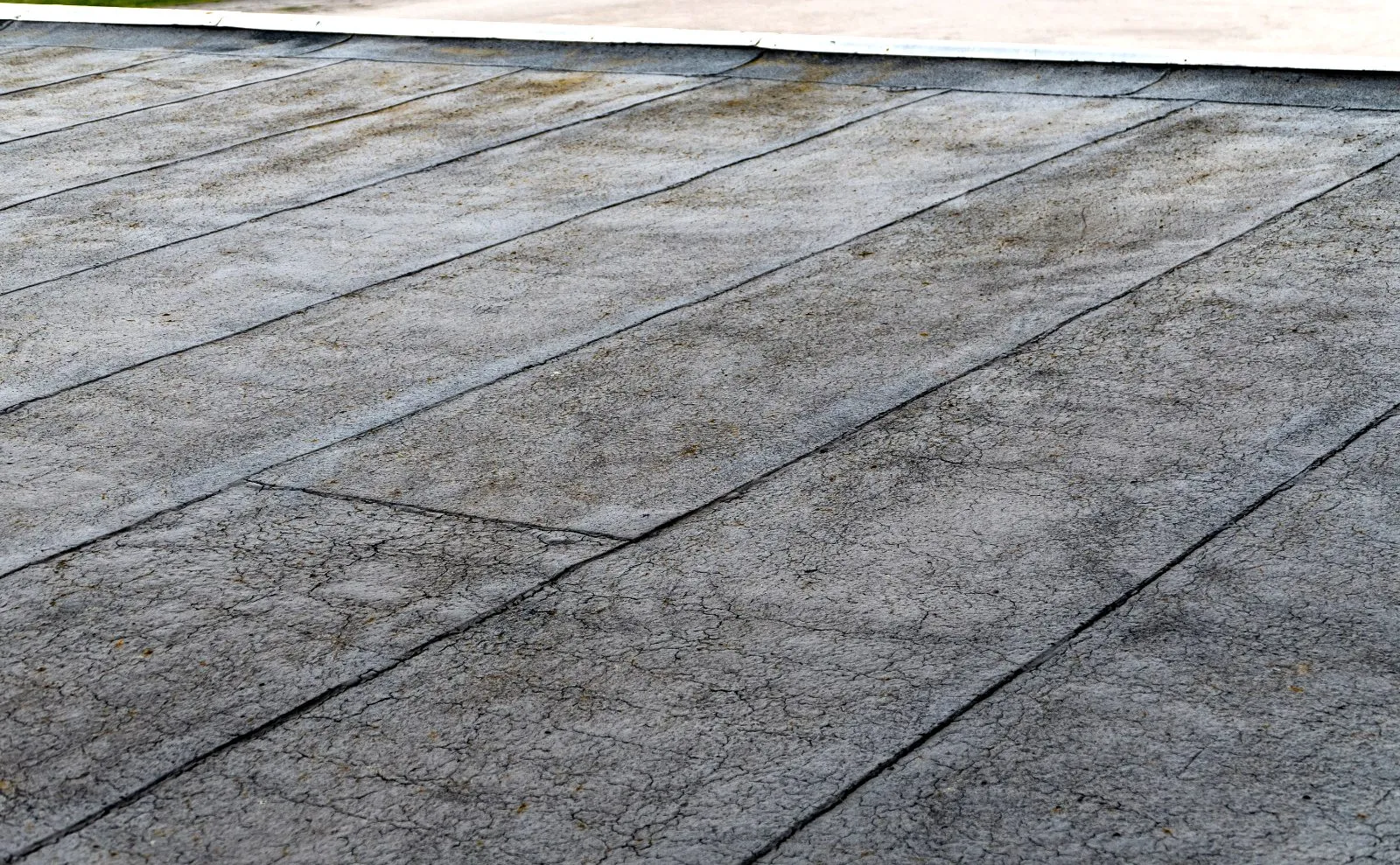
Felt has a bad name from old roofs laid with hot bitumen, which blistered and cracked within a decade or two. Modern torch-on is two or three polymer-modified layers under a mineral-finished cap sheet. A damaged top layer still has one underneath, and it patches easily.
The drawback is the gas torch. An open flame beside timber fascias, a wooden window or a neighbour's roof is a real fire risk, which is why many roofs near timber are now done in a cold-applied system instead. And felt's laps (the overlaps between strips) are where it eventually lets water in.
Choosing for your roof: four questions
Start with the roof, not the material. If a felt roof has a small leak but is otherwise sound, it's a repair, not a reason to change system. The choice only opens up when the old covering has failed across the roof and the deck is going soft, because then it all comes off, whatever goes back on. From there, pick the system for how the roof is used and what surrounds it. These four questions usually settle the choice:
Whether anyone walks on it
A terrace or a route to clean windows needs GRP with an anti-slip topcoat.
The shape of the roof
A plain rectangle suits one EPDM sheet. Corners and pipes suit GRP.
What's right next to it
Timber close by makes a flame risky. EPDM and GRP go on cold.
How well the old felt did
If it lasted decades and wore out, modern torch-on is a fair like-for-like choice.
What affects the cost of a new flat roof
I don't publish prices: each flat roof is priced after I've looked at it, with a free written quote, and you pay the price we agreed. The system matters less than these:
- Size and access: a garage off the drive is a different job from a roof above a conservatory. If scaffolding is needed, I arrange it and it's in the quote.
- The deck: rotten boards under the old covering must be replaced first.
- Details: every upstand, outlet and vent pipe takes time, whichever system you choose.
- Insulation: if the Building Regulations apply (below).
If I find more work once the job has started, I talk it through with you first.
Insulation, building control and guarantees
Replacing a flat roof covering counts as renovating the roof under Approved Document L, the government's guidance on energy efficiency (gov.uk, Approved Document L). If more than half the roof, or more than a quarter of the building's whole outer envelope, is renovated, the whole roof should be insulated to a U-value of 0.16 W/m²K where that's practical, and a new roof to 0.15. Below that, re-covering normally needs no building control application.
That usually means a warm roof: insulation boards on top of the deck, under the new covering, which keeps condensation out of the timbers. On a flat roof I replace, the insulation goes in as a warm roof, and I help you with the building control notification.
Any new flat roof I fit comes with my written 20-year guarantee; repairs get at least 5 years.
EPDM vs GRP vs felt, side by side
Typical behaviour across the trade, not promises.
| EPDM rubber | GRP fibreglass | Torch-on felt | |
|---|---|---|---|
| Joins on a small roof | Usually none: one sheet | None: one cured skin | Overlapping laps between strips |
| Flame on the roof | No, glued down cold | No, resin cures cold | Yes, each layer is torched |
| Walking on it | Occasional access only | Yes, with an anti-slip topcoat | Occasional access only |
| If the deck moves | Flexes with it | Can crack at board joints | Copes with small movement |
| Usual weak spot | Edges, trims and punctures | Cracks, and poor laminating | Laps, and blisters on old felt |
| Repairs | Patched with primer and tape | Ground back and re-laminated | Patched with a new layer |
| Typical lifespan | Typically 20 years or more | Typically 25 years or more | Typically around 20 years |
EPDM suits plain garages and extensions nobody walks on. GRP suits dormers, awkward shapes and roofs used as a floor. Modern torch-on suits a like-for-like re-cover with no timber close by.
Questions about choosing a flat roof
Which is better for a flat roof: EPDM, GRP or felt?
None of them is better on every roof: the right one depends on the roof's shape, whether anyone walks on it, and what's next to it. EPDM for a plain roof nobody uses, GRP for awkward shapes and walkable roofs, torch-on for a like-for-like re-cover away from timber.
Is it worth replacing a felt flat roof with EPDM or GRP?
It's worth it when the felt has failed and has to come off anyway, and the roof is walked on, awkwardly shaped or close to timber. If old felt lasted decades and simply wore out, modern torch-on is a fair like-for-like choice.
Can EPDM or GRP go over an old felt roof?
Sometimes, but stripping back to the deck is usually the better job. Laying over old felt hides soft boards or water trapped between layers. With the old covering off, rotten boards can be replaced before the new roof goes on.
Related pages
Flat roofing in Oxford
Repairs, re-covering and maintenance, in all three systems.
EPDM rubber roofing
Trims and upstands: the detail that decides how long rubber lasts.
GRP fibreglass roofing
Resin, glass mat and topcoat, and why weather sets the start date.
Ask me which flat roof suits yours
Send a photo of your flat roof on WhatsApp, or ring 07306 077999. I'll tell you which system suits it after a free visit, usually the next day, with a free written quote.
No call-out charge, day or night